The Theory of Related-ivity: Segment XI
Wednesday, April 8, 2026 - 10:45

The Theory of Related-ivity:
A History and Analysis of the Best Related Work Hugo Category
by Heather Rose Jones
(This is a serialized article exploring the history of the Best Related Work Hugo category in its various names and versions. If you’ve come in at the middle, start here.)
Contents
Part 3: Historic Trends
3.3 Category
3.3.2 Most Popular Categories
3.3.2.1 Art Books
3.3.2.2 Criticism
3.3.2.3 Essays
Part 3: Historic Trends
3.3 Category
3.3.2 Most Popular Categories
In addition to the standard distribution statistics, the most popular categories have a discussion of any changes in popularity across the three eras and the relationship of Finalists to Winners. The specific Topics are summarized, as well as any repeating authors (or People appearing as Topics) and gender ratios for authors (and Topics, if relevant).
Works whose classification includes one of the “most popular” categories make up 260 out of the total 609 works (43%), keeping in mind that many works fall in more than one Category.
3.3.2.1 Art Books
Definition: Display, discussion, or criticism where the primary content is visual Art. This would not include discussions of art or artists where the inclusion of images is not the main focus.
This definition excludes works that fit better under comics/sequential art, which fall under the Graphic Category. Types of works include collections of the work of specific artists, images by multiple artists (e.g., the Spectrum volumes), or works focused on a specific media Property or Topic. Works that fall under Art may also interact with another Category such as Biography, Fiction (especially a fictional narrative that mimics a scientific reference), or Science. A couple works are tagged both Art and Graphic when categorization was difficult.
Overall, 94 works (15% of the full data set) are classified as Art. In the 46 years in which Best Related has existed they appear as follows:
Best Non-Fiction Book
- Finalists in 13 out of 18 years (72%)
- 20% of Finalists
- 6% of Winners
- (Long List data not available)
Best Related Book
- Finalists in 9 out of 12 years (75%)
- 29% of Finalists
- 33% of Winners
- Long List in 11 years (92%)
- 25% of Long List
Best Related Work
- Finalists in 1 out of 16 years (6%)
- 1% of Finalists
- No Winners
- Long list in 8 years (50%)
- 4% of Long List
Figures 15 and 16 show the percentage for each year that Art appeared as Finalist or Long List.
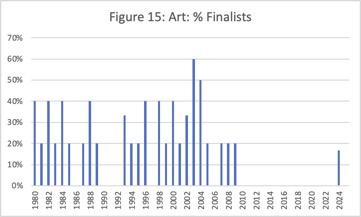
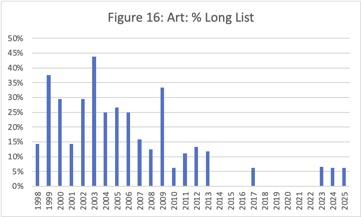
Art Books have been a mainstay of the Best Related category since its inception but have not been evenly distributed. Art Books were a substantial presence in Finalists during the Non-Fiction era, though they did not win in proportional numbers. Then in the Related Book era Art Books increased their presence significantly in all measures, and won in proportion to their presence as Finalists. In the Related Work era this presence dropped substantially, functionally disappearing from Finalists and dropping off the Long List, for the most part, after the first 4 years. This pattern gives strong evidence for nominations being affected by how the category is framed. Nominators may have been more willing to consider Art-forward Books to be in scope once the category wasn’t labeled “non-fiction.” It seems unlikely that expanding the scope to Related Work made people consider Art Books to be out of scope. It is possible that the expansion to include other content types simply pulled nominations away from Art Books but there isn’t clear evidence on this topic.
A change in priority needn’t be the sole explanation. For example, 16 out of the total of 94 works (17%) were published by Paper Tiger Books, which operated during the first two eras but went out of business around the change to Related Work. The only other Publisher represented more than a couple times in the Art data is Underwood Books with 21 works, including 17 volumes of the annual, Spectrum: The Best in Contemporary Fantastic Art. The Spectrum volumes appear on the Long List every year from the first one in 1995 through the 18th in 2012 (only missing volume 3). They were Finalists 8 of those times, more commonly toward the beginning of the run. Two years after volume 18, the original editors Cathy and Arnie Fenner handed off the Series to a different editor and Publisher. The change in editors might well explain the loss of interest in the Series, though not the disappearance of the Series in the last two years of the Fenners’ tenure. But whatever the reason, the disappearance of Paper Tiger Books and changes to the Spectrum Series at least correlate with the fall-off in Art Books in the data, whether or not they are a direct cause. Other speculative reasons for the fall-off could be that the overall shift to e-books disadvantaged works that rely on images, or that presentations of artwork moved to online-only venues due to the expense of hard-copy art publication.
69 works feature the Art of specific artists or are portfolios of a collection of specific artists, 11 feature Art associated with a specific media Property, while 16 relate to other topics with half containing illustrations accompanied by fictional narratives, typically fictionalized Science or History. Of these, the first two groups appear proportionately across the three eras, while the last group does not appear during the Related Work era. But is this due to nominators not choosing Art Books focused on “other topics” or has that type of Book become less common?
The present analysis is not in a position to answer these questions with any certainty. A survey of changes in the number of Art Books being published would be informative but would need careful study design. See also the discussion of the special Art Books Hugo category in 2019 (in the section on Overlapping Categories under Special Categories).
Subjects
Among the works focused on the Art of a specific person, there are a few repeat appearances. (There will be a more general consideration of People as Topics in the Other Tags section.) The work of the following artists was nominated more than once:
- Bob Eggleton - Finalist in 1996, Finalist and Winner in 2001
- David A. Cherry - Finalist in 1988, ineligible repeat of the same work on the Long List in 1989
- Frank R. Paul - Long List in 2010 and 2013
- John Picacio - Finalist in 2007, Long List in 2013
- Leo Dillon and Diane Dillon - Finalist in 1982, Long List in 1999
- Michael Whelan - Finalist and Winner in 1988, Finalist in 1980 and 1994
Two media Properties are the Topic of more than one work, perhaps the two most popular SFF visual Properties:
- Lord of the Rings - Long List in 2003 and 2006
- Star Wars - Long List in 2006 and 2017
Among other Topics, there are repeat appearances for works about dragons (Finalist in 2003, Long List in 1980), space travel (Finalist in 2005, Long List in 2004), and speculative zoology/biology (Finalists in 1980 and 1982, Long List in 1989).
Art works are heavily male in authorship (this is the author/editor of the work, not the subject matter). Out of the 96 works, 8 (8%) are solely non-male authored, 26 (27%) have mixed-gender authorship, and 62 (65%) are solely male authored. But while the overall trends in gender show a shift to more equality in the Related Work era, the majority of the non-male authored Art Books occur during the two earlier eras.
The gender of the artists whose work is featured (here excluding collections of multiple artists) is even more skewed. Of the 44 works featuring named artists, 2 subjects (5%) are non-male, 4 (9%) have mixed subjects, and 36 (82%) have male subjects. Once more, the non-male subjects occur during the two earlier eras. What would be more difficult to determine is the proportion of genders in published Art Books during the different eras. That is: does this represent the works available for nomination or the priorities of the nominators?
Best Art Book was held as a special category in 2019. In general, the works nominated in that category align with the types of Art Books nominated under Best Related, but in different proportions. Only 4 works focused on specific artists, all of whom also appear somewhere in the Best Related data. The majority of works focused on media Properties, though only Lord of the Rings (with two works) overlaps with the Best Related Topics. One of the four artist-Topics was female. Gender was not researched for the authors of the Best Art Book nominees. Spectrum: The Best in Contemporary Fantastic Art volume 25 shows up as a Finalist. As noted in the discussion of special Hugo categories, the nominating numbers for Best Art Book were relatively low and the idea was not pursued further. This suggests that the lower nomination numbers of Art Books in the Related Work era may be due to a general loss of interest in Art Books although, as noted earlier, several of the works nominated under Best Art Book may have had numbers sufficient to make the Long List or even Finalist if they had appeared in Best Related that year.[1] So both hypotheses—loss of interest and being pushed out by other types of works—may play a part.
Conclusions
Art Books show the most dramatic changes over the lifetime of Best Related, although those changes are as likely to have been affected by external factors within the publishing industry as by changes in nominator attitudes towards the category. The perception among supporters of Art Books that they were no longer being recognized to the same extent as previously within the Best Related category is well supported, but the disappointing results of the special category trial suggest that this was not due to other types of works “pushing out” Art Books during the nomination process. Art Books have been heavily skewed toward both male authorship and a focus on male artists and the overall shift towards gender parity in the Related Work era did not affect Art Books, though as with other Categories it’s unclear whether this is driven by publishing trends or nomination trends.
3.3.2.2 Criticism
Definition: An analytical discussion of a subject or work that generally relates it to a larger framework of ideas or experiences. This Category can have very fuzzy boundaries with Essays, Reviews, and some others.
About a quarter of the individual works are cross-categorized, most commonly with Essays, less commonly with History, Memoir, Reference, and Reviews.
Overall, 86 works (14% of the full data set) are classified as Criticism. In the 46 years in which Best Related has existed they appear as follows:
Best Non-Fiction Book
- Finalists in 6 out of 18 years (33%)
- 9% of Finalists
- 6% of Winners
- (Long List data not available)
Best Related Book
- Finalists in 6 out of 12 years (50%)
- 13% of Finalists
- 8% of Winners
- Long List in 9 years (75%)
- 15% of Long List
Best Related Work
- Finalists in 8 out of 16 years (50%)
- 14% of Finalists
- 13%Winners
- Long list in 13 years (81%)
- 16% of Long List
Figures 17 and 18 show the percentage for each year that Criticism appeared as Finalist or Long List.
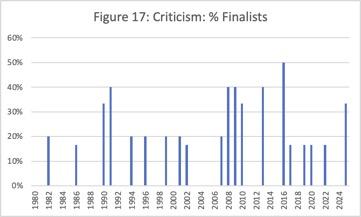
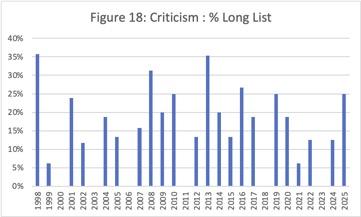
Criticism has, in general, increased slightly in frequency across the three eras. As seen in the statistics and figures, the overall increase during the Related Work era doesn’t correspond to a sharp change of behavior. The presence of Criticism, while variable in any given year, is consistent. There is a possible cluster of higher interest from 2007-2010, but there is no other common factor to those works that might suggest anything other than chance. Works of Criticism have won in all three eras, but only in the Related Work era do they win in proportion to their presence among Finalists, being slightly under-represented in the two earlier eras.
The following Topics appear multiple times in works of Criticism:
- Studies of the body of work of a specific author or literary set (18) including multiple studies of J.R.R. Tolkien (3), the Inklings (2), Joanna Russ (2), and Ken MacLeod (2)
- Science Fiction literature in general (16) including specifically French SF and YA SF
- Issues around representation (12) including disability (4), race (4), and women, motherhood, and feminism (4)
- Studies of a particular Property (11) including multiple works about Harry Potter (2) and The Hobbit (2)
- Collections of critical analysis on various topics by a specific author (8)
- Fantasy literature in general (3)
- Games and gaming culture (3)
- Movies in general (2)
- A number of other works don’t fall into any obvious group.
A fairly large number of authors have more than one work in this Category, but only 3 appear as authors of 3 or more works:
- Farah Mendlesohn (7)
- Andrew M. Butler (4)
- Elsa Sjunneson (3)
Authors of critical works are, on the whole, less skewed toward male authorship than the dataset as a whole, with 56% all-male authorship, 34% all non-male authorship, and 9% mixed-gender authorship.
By definition, in the Non-Fiction and Related Book eras, Criticism only appears in Book format. In the Related Work era, out of the 42 Criticism works, 29 (69%) are Books with other formats beginning to appear in 2014, primarily Article/Blog (19%), less commonly Video, Speech, and Dissertation. These numbers are roughly equivalent to the overall distribution of Media formats in the Related Work era. Video Criticism (the only non-textual format) always has a visual work as its subject, though visual works also appear as the subject of text-based Criticism.
Conclusions
Overall, there are no unusual or unexpected observations with respect to works of Criticism, other than the authorship being less skewed towards male authors than the overall data set. Criticism works form a significant subset of nominations and generally represent what might be thought of as traditional content.
3.3.2.3 Essays
Definition: A discussion or presentation, generally on a specific topic, usually expressing some degree of personal opinion by the author. This Category can have very fuzzy boundaries with Criticism, Reviews, and some others.
Essays frequently co-occur with other categories. Small numbers of works co-occur with Autobiography, Biography, and Humor, while more significant numbers co-occur with Criticism (12), Reviews (8), or Fiction (5).
Overall, 93 works (15% of the full data set) are classified as Essays. In the 46 years in which Best Related has existed they appear as follows:
Best Non-Fiction Book
- Finalists in 12 out of 18 years (67%)
- 17% of Finalists
- No Winners
- (Long List data not available)
Best Related Book
- Finalists in 6 out of 12 years (50%)
- 13% of Finalists
- 17% of Winners
- Long List in 11 years (92%)
- 12% of Long List
Best Related Work
- Finalists in 9 out of 16 years (56%)
- 14% of Finalists
- 19%Winners
- Long list in 15 years (94%)
- 17% of Long List
Figures 19 and 20 show the percentage for each year that Essays appeared as Finalist or Long List.
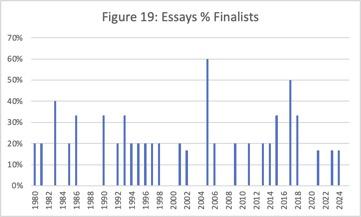
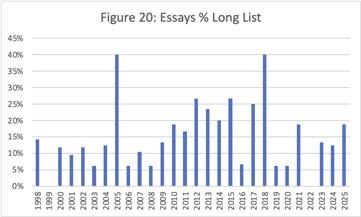
Essays are proportionately most frequent among Finalists in the Non-Fiction era especially in the later part of the era, but produced no Winners. In contrast, Essays won in greater proportion to their appearance as Finalists in the later two eras. They appear very consistently on the Long List, showing up in more than 90% of years for the two later eras. The start of the Related Work era sees a sustained increase in Essays on the Long List for nearly a decade (interrupted only by 2016)[2] followed by a falloff in more recent years.
Two significant types of Essay content are collections of the work of a particular author, usually on a variety of subjects (39), or a collection of Essays relating to a specific subject: Person (18), Property (5), or Topic (see below). Works revolving around a specific Topic may have a single author or be a collection of multiple authors, or in the Related Work era may be a single Essay on the Topic (although single Essays are rarely nominated in this Category). The following Topics occur more than once:
- Fantasy (2)
- Feminism (3)
- Futurism (2)
- Representation (6)
- Science Fiction (6)
Certain authors/editors appear multiple times in the Essay Category, with more repeats and greater frequency than in almost any other Category. The following authors have multiple works (counting for each author in the case of multi-author works).
- David Langford (6)
- Ursula K. Le Guin (5)
- Farah Mendlesohn (4)
- Harlan Ellison (3)
- John Scalzi (3)
- Lynne M. Thomas (3)
- Neil Gaiman (3)
- Edward James (3)
- Gwyneth Jones (2)
- Jim C. Hines (2)
- Joanna Russ (2)
- John Clute (2)
- Robert Silverberg (2)
- Teresa Nielsen Hayden (2)
- Sigrid Ellis (2)
- Robert J. Sawyer (2)
Overall, Essay authorship skews less male than the overall dataset, with 56% male-only, 34% non-male-only, and 10% mixed authorship.
Books make up the primary Media format for Essays in the Related Work era with 40 out of 45 works (89%). Article/Blog makes up most of the remainder, appearing first in 2018, with one Video work. The over-representation of textual formats may be unsurprising for Essays, though one might also have expected it for Criticism.
Conclusions
Very much like Criticism, the Essay Category shows no unusual or unexpected observations. They form a significant subset of nominations and generally represent what might be thought of as traditional works.
Major category: